
What Is Business Valuation and Why It Matters for Fundraising
Business valuation determines the financial worth of a company and plays a crucial role during fundraising. Investors rely on valuation to assess risk, potential returns, and ownership stakes before committing capital.

Overview
What Is Business Valuation?
- Revenue and growth rate
- Profitability or path to profitability
- Market size and competitive position
- Business model and unit economics
- Risk profile and execution track record
For early-stage companies, valuation is less about historical performance and more about future expectations. That is why startup valuation often feels subjective. Two companies with similar revenue can receive very different valuations based on narrative, market timing, and perceived upside. At its core, business valuation answers one question: how much would an informed buyer or investor be willing to pay for this company today?
How Startup Valuation Works in Fundraising?
For example:
- If your startup valuation is $5 million and you raise $1 million, you give up roughly 20 percent of the company.
- If the valuation is $10 million for the same raise, dilution drops to about 10 percent.
This makes valuation one of the most important levers in fundraising. It directly shapes founder ownership, future rounds, and long-term outcomes.
Unlike public companies, startups are not valued on a stock exchange. Instead, valuation emerges from negotiation between founders and investors, informed by:
- Comparable deals in your sector
- Revenue multiples for similar companies
- Growth expectations
- Risk and stage of development
- Strength of your team and story
Your financial model, pitch deck, and traction all feed into this process.
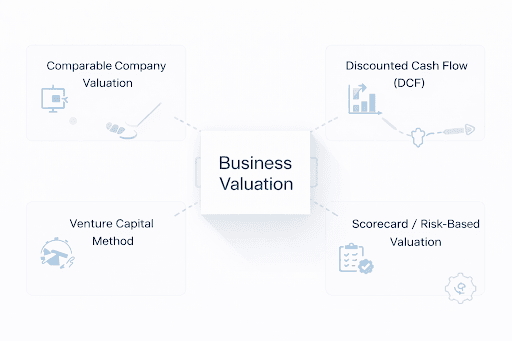
Common Types of Business Valuation
- Comparable Company Valuation: This method looks at similar companies in your industry and stage and applies their revenue or user multiples to your business. For example, if comparable startups are raising at six times revenue and you generate $1 million annually, your implied valuation may be around $6 million. This is the most common anchor for startup valuation because it reflects real market behavior.
- Discounted Cash Flow (DCF): DCF estimates the present value of your future cash flows. It is more common for mature businesses with predictable revenue. Early-stage startups rarely rely on DCF alone because projections are highly uncertain. Still, it becomes useful in later-stage fundraising and internal planning.
- Venture Capital Method: This approach works backward from a target exit value. Investors estimate what your company could be worth at exit and then calculate today's valuation based on their required return. For example, if an investor expects a ten times return and believes your company could be worth $100 million at exit, today's valuation may land around $10 million.
- Scorecard and Risk-Based Methods: Used mainly for pre-revenue or seed-stage companies, these methods adjust valuation based on factors such as:
- Team strength
- Market size
- Product readiness
- Competitive risk
- Traction
They help structure early startup valuation when financial data is limited.
Why Business Valuation Matters So Much?
A well-supported valuation:
- Signals credibility and preparedness
- Aligns expectations with investors
- Preserves founder ownership
- Leaves room for future fundraising
- Builds confidence in your strategy
An inflated valuation can feel like a win in the short term, but it raises the bar for future growth. If performance does not match expectations, later rounds become harder and more dilutive.
A valuation that is too low, on the other hand, may secure quick funding but permanently reduces founder equity. Strong fundraising is about finding the right balance between ambition and realism.
What Investors Look For in Valuation?
- Market size and expansion potential
- Revenue quality and predictability
- Unit economics and margins
- Growth trajectory
- Capital efficiency
- Team capability
Your startup valuation becomes credible when these elements tell a coherent story. Financial projections should connect clearly to market assumptions. Growth plans should feel achievable. Risks should be understood and addressed.
Valuation is less about defending a single number and more about demonstrating that you understand your business deeply.
The Bottom Line
A thoughtful startup valuation does more than close a round. It sets the tone for every stage that follows.