
Market Research
6 min read
Market Sizing and TAM, SAM, SOM Explained
Market sizing helps businesses and investors understand the true scale of an opportunity. This guide explains TAM, SAM, and SOM, how they work, and why they matter for strategy and fundraising.
Overview
Every growth plan starts with a simple question: how big is the opportunity? Market sizing exists to answer that question with clarity. Whether you are launching a startup, entering a new segment, or preparing for fundraising, investors and leaders will want to understand the scale of what you are building. This is where TAM, SAM, and SOM come in. Together, they provide a structured way to frame opportunity and realism. In this guide, we explain what market sizing means, how TAM SAM SOM works, and why these concepts matter for strategy and capital raising.
What Is Market Sizing?
Market sizing is the process of estimating how large a market is in terms of revenue or customers. It answers questions like:
- How much could this market be worth
- How many buyers exist
- How fast is the market growing
- How much of it can we realistically capture
Good market sizing is not about optimism. It is about credibility. It grounds ambition in data and shows that your plans are based on understanding rather than hope.
Understanding TAM, SAM, and SOM
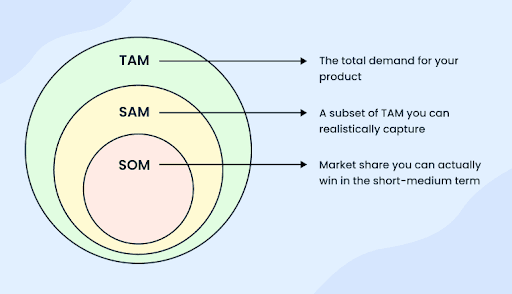
TAM, SAM, and SOM are three layers of market sizing. Each narrows the view from total possibility to realistic capture.
- Total Addressable Market (TAM): TAM represents the total demand for your product or service if you captured 100 percent of the market. It answers the question: if every potential customer bought from us, how big could this be? For example, if there are 10 million businesses globally that could use your software at $1,000 per year, your TAM is $10 billion. TAM shows the ceiling of the opportunity.
- Serviceable Available Market (SAM): SAM is the portion of the TAM you can serve with your current product, geography, or business model. If your product only targets small businesses in North America, then your SAM is the subset of the TAM that fits those constraints. SAM answers: which part of the total market is actually within reach?
- Serviceable Obtainable Market (SOM): SOM is the share of the SAM that you can realistically capture in the near to medium term. This is where strategy meets reality. SOM reflects:
- Competition
- Sales capacity
- Pricing
- Market maturity
- Execution speed
SOM answers: what portion of the market can we win?
How Market Sizing Works in Practice
There are two common approaches to market sizing.
- Top-Down: You start with a large industry figure and narrow it using assumptions. For example: global industry size, percentage relevant to your segment, and percentage reachable in your geography. This method is fast and useful for framing, but it depends heavily on assumptions.
- Bottom-Up: You build from real data such as number of target customers, average revenue per customer, and sales capacity and conversion rates. Bottom-up market sizing is more credible, especially for startups, because it ties opportunity to how the business actually grows.
Strong TAM SAM SOM analysis often blends both methods.
Why Investors Care About TAM SAM SOM
Market sizing is not just a slide in a deck. It signals how you think. Investors use TAM SAM SOM to assess:
- Whether the opportunity is large enough to matter
- If your growth goals are realistic
- How defensible your niche is
- Whether returns can justify risk
A massive TAM with no clear path to SOM feels theoretical. A small TAM with strong execution can still be attractive. What matters is coherence between the story and the numbers.
Common Mistakes in Market Sizing
Founders often fall into predictable traps:
- Using industry headlines as TAM without filtering
- Treating TAM as guaranteed revenue
- Skipping SAM and jumping straight to SOM
- Ignoring competition
- Using numbers that cannot be explained
Good market sizing is defensible. You should be able to walk someone through every assumption.
The Bottom Line
Market sizing turns ambition into structure. TAM SAM SOM provides a clear way to show the scale of opportunity and the path to capturing it. TAM defines the ceiling. SAM defines the reachable space. SOM defines what you can realistically win. Together, they help founders, executives, and investors align around what is possible and what is probable. In strategy and fundraising alike, clarity beats exaggeration. Market sizing is how that clarity is built.