
Financial Planning & Analysis (FP&A) Explained
As companies grow, decisions become more interconnected. Hiring affects cash. Pricing affects margins. Marketing affects runway. What once felt intuitive now requires structure.
Overview
This is where Financial Planning and Analysis, or FP&A, becomes essential.
FP&A sits at the center of how a business plans, measures, and adapts. It connects strategy to numbers and turns financial data into forward-looking insight. Through FP&A services, companies gain the ability to forecast performance, understand drivers, and make decisions with confidence.
In this guide, we explain what FP&A is, how it works, and why it has become a core function for modern businesses.
What Is FP&A?
- Budgeting and forecasting
- Performance tracking
- Variance analysis
- Scenario planning
- Strategic financial modeling
- Management reporting
While accounting tells you what already happened, FP&A helps you understand what is happening now and what is likely to happen next.
FP&A answers questions such as:
- Are we on track to hit our goals
- What is driving overperformance or shortfalls
- How much runway do we have
- What happens if growth slows
- Can we afford this hire or investment
In other words, FP&A turns financial data into decision support.
How FP&A Works
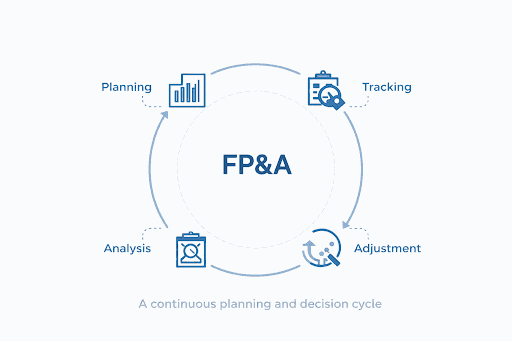
- Planning: The team builds budgets and forecasts based on strategy. This includes revenue projections, cost structures, hiring plans, and capital needs. These plans define what success looks like in numbers.
- Tracking: Actual performance is measured against the plan. Monthly and quarterly results are compared to forecasts. This creates visibility into what is working and what is not.
- Analysis: FP&A teams investigate the “why” behind results. They identify growth drivers, cost overruns, efficiency gaps, and emerging risks. This step transforms raw financials into insight.
- Adjustment: Plans are refined. Scenarios are updated. Leadership adapts strategy based on reality. FP&A is not a one-time exercise. It is an operating rhythm.
What FP&A Services Provide
These services typically include:
- Budget and forecast development
- Financial modeling and scenario planning
- KPI framework design
- Management dashboards
- Monthly performance analysis
- Strategic decision support
Rather than building everything in-house, companies gain structured planning and analysis from experienced professionals.
FP&A services act as a financial nerve center for leadership.
Why FP&A Matters
Strong FP&A:
- Improves forecast accuracy
- Reveals hidden drivers of performance
- Aligns teams around measurable goals
- Reduces financial surprises
- Supports confident decision-making
It replaces reactive management with proactive control.
As complexity increases, clarity becomes a competitive advantage.
Who Needs FP&A?
- Revenue is growing quickly
- Costs are rising unevenly
- Cash runway matters
- Teams are expanding
- Investors expect discipline
- Decisions have long-term impact
Most companies do not need a large finance department to benefit from FP&A. They need structure, foresight, and interpretation.
That is what FP&A services provide.
The Bottom Line
Through FP&A services, companies gain the ability to plan intelligently, measure accurately, and adapt quickly. It connects vision to reality and replaces guesswork with discipline.
As businesses scale, success depends less on effort and more on alignment.
FP&A is how that alignment is built.