
AI in Business Analytics
Businesses generate more data than ever before. Sales systems, customer platforms, operations, and marketing tools all produce constant streams of information. The challenge is no longer access to data. It is turning that data into timely, useful insight.

Overview
This is where AI enters business analytics.
AI analytics applies machine learning and automation to the process of analyzing data. Instead of relying only on manual queries and static reports, organizations can uncover patterns, predict outcomes, and act in near real time. What once took teams weeks can now happen continuously in the background.
In this guide, we explain what AI in business analytics really means, how it works, and why it is reshaping how organizations make decisions.

What Is AI in Business Analytics?
- Detecting patterns humans might miss
- Predicting future outcomes
- Identifying anomalies in real time
- Recommending actions
- Learning and improving over time
Rather than asking only “what happened,” AI helps answer “what will happen next” and “what should we do about it.”
This shifts analytics from retrospective reporting to forward-looking guidance.
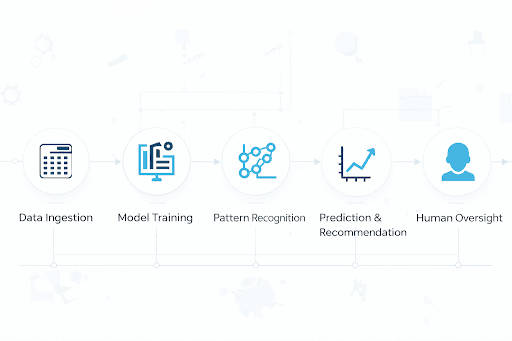
How AI Analytics Works
- Data Ingestion: AI systems pull data from multiple sources such as finance tools, CRMs, product platforms, and external feeds. The goal is to create a unified view of the business.
- Model Training: Machine learning models are trained on historical data. They learn relationships between variables, such as how pricing changes affect demand or how behavior predicts churn.
- Pattern Recognition: Once trained, models scan new data continuously. They identify trends, correlations, and outliers without manual intervention.
- Prediction and Recommendation: AI analytics generates forecasts and suggestions. Examples include: predicting customer churn, forecasting revenue, identifying operational bottlenecks, recommending next-best actions. These insights update as new data arrives.
- Human Oversight: AI does not replace judgment. Teams review, validate, and act on insights. Over time, models are refined based on outcomes. The result is a living analytics system that evolves with the business.
Where AI Analytics Is Used
- Sales teams use it to prioritize leads and forecast pipelines
- Marketing teams optimize spend and targeting
- Operations teams detect inefficiencies and risks
- Finance teams improve forecasting and scenario planning
- Product teams understand behavior and retention
In each case, AI analytics reduces manual effort and improves speed.
Benefits of AI in Business Analytics
- Faster insight
- More accurate forecasts
- Continuous monitoring
- Early risk detection
- Scalable decision support
Instead of waiting for monthly reports, leaders see signals as they emerge. This allows businesses to move from reactive management to proactive strategy.
Challenges to Consider
- Data quality becomes critical
- Models require oversight
- Bias can be embedded in training data
- Teams must trust and understand outputs
Successful adoption depends on combining technology with strong governance and clear communication.
AI is most powerful when paired with domain expertise.
The Bottom Line
Through AI analytics, companies gain the ability to anticipate change, respond faster, and make better decisions at scale. In an environment defined by speed and complexity, that capability is no longer optional. It is becoming foundational to how modern businesses operate.